The €40,000 phantom revision: master ECO/ECR before they cost you dearly
Published June 25, 2026, updated September 29, 2026 — the story of a change that should never have reached production, and the 6-step method that would have stopped it.
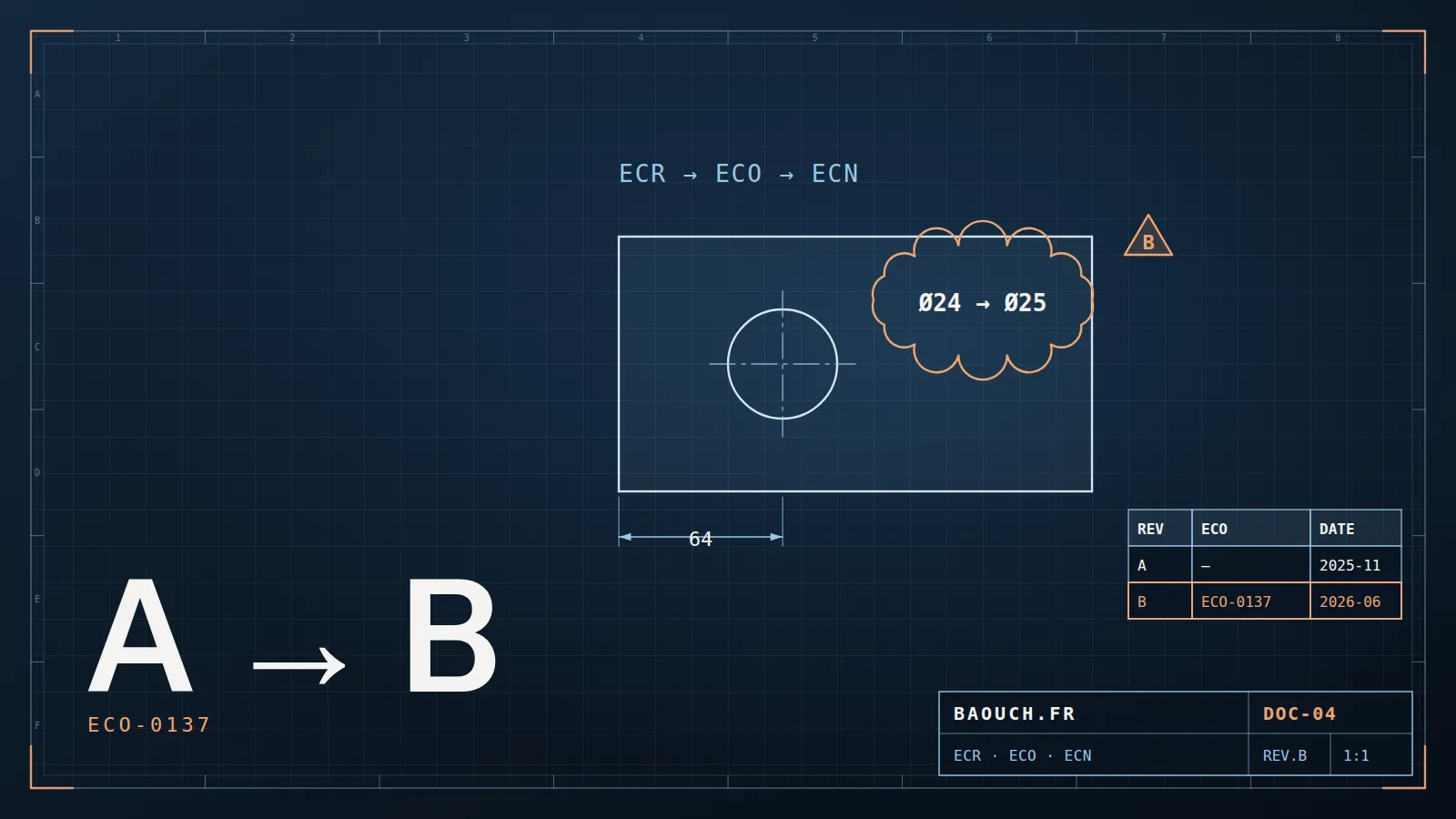
One Monday morning, a project manager calls me, pale-voiced. Their latest delivered machine is back for service: a seal won't hold. Tracing it back, we find that an engineer had modified the seal groove three months earlier, "to improve assembly." Good idea, wrong seal ordered afterwards. Nobody told purchasing. The old part was still sitting in stock — €40,000 of components now unusable, plus the service trip, plus a customer starting to doubt.
The worst part? Technically, the change was good. It wasn't the engineer who failed. It was the absence of a process. The part went from drawing to production without any review asking the one question that matters: "who is affected by this change, and what do we do with the parts already in circulation?"
That's exactly what an ECR/ECO process is for. Nothing exotic, nothing heavy. Just a way to make sure a change never wanders off on its own. Stay with me to the end: I'll show you the 6 steps, the crucial difference between ECR and ECO, and the "phantom" revision trap that cost those €40,000.
In short: the ECR (Engineering Change Request) is the change request, the ECO (Engineering Change Order) is the order that applies it after impact analysis and decision, and the ECN (Engineering Change Notice) informs those who must apply it. A well-managed change always has an effective date, and results either in a new revision or a new part number, depending on whether the part stays interchangeable.
One question to keep in mind as you read: in your company, today, how is a part change decided? If the answer is "the engineer changes the drawing and saves," you carry the same risk as that client.
1. ECR vs ECO: two words, two moments
People often mix the two, and that's where everything gets blurred. Hold on to this distinction — it structures everything else:
ECR — Engineering Change Request
This is the request. "I propose changing X for this reason." It describes the problem, the expected benefit, an initial idea of a solution. Nothing is decided yet, nothing is changed yet.
ECO — Engineering Change Order
This is the decision and its execution. Once the ECR is approved, the ECO lists precisely what changes (parts, drawings, BOM, revisions), who does what, and — above all — how the existing stock is handled.
Why separate the two? Because not every request becomes an order. An ECR lets you evaluate without committing: sometimes you decline, sometimes you bundle several requests into one ECO. Skipping the ECR step means changing first and thinking later — exactly what happened to our seal.
An ECR that goes nowhere is a success, not a failure: it means you evaluated an idea and knowingly chose not to apply it. What costs money isn't declined requests — it's changes applied without ever having been requested.Mohamed Omar Baouch

2. The 6-step process
Here's the backbone I deploy, whatever the company size. It fits on one page. It's not its complexity that makes it effective — it's the fact that no step is skipped.
The heart of the engine is step 2 (impact analysis). It's what would have caught our seal: "this groove changes ⇒ new seal ⇒ old seal in stock ⇒ €40,000 to use up or write off." Thirty minutes of review would have prevented everything.
The golden rule of step 5: a change always has an effective date. "Effective next batch," "when stock runs out," "immediate recall." Without an effective date, an ECO is a wish, not an order.
3. The phantom revision — the in-transit parts trap
Here's the exact trap that makes changes so dangerous. When you move a part from revision B to revision C, there is never a single "state" of that part in the company. At any moment, it exists simultaneously:
- at revision C in the PDM (engineering's truth),
- at revision B in the work orders already launched,
- at revision B in the stock of components already purchased,
- at revision A or B in the machines already at customers' sites.
The "phantom revision" is that intermediate level still circulating while engineering thinks it's dead. The drawing says C, the shop assembles B, service repairs A. Nobody is lying — nobody has the same map.
This curve sums up the stakes better than any speech: the ECO process isn't paperwork — it's what keeps you on the left side of the curve.
New revision or new part number? The interchangeability rule
The phantom revision becomes dangerous when two non-interchangeable parts share the same part number. The most widespread rule, often called form, fit, function: if the new part can replace the old one everywhere (same interface form, same fit, same function), keep the part number and move to the next revision; otherwise create a new part number, so stock, work orders and service can no longer confuse the two.
Each company must write and keep its own rule, but the criterion stays the same: can the old and new part be mixed safely? If not, a mere revision change leaves the door open to the phantom revision. Numbering itself (sequential or meaningful) is covered in SOLIDWORKS numbering and properties.
4. Do you need a PLM to manage changes?
Honest answer: no, not to begin with. I've seen 20-person shops run a flawless ECR/ECO process with a shared form and a 30-minute weekly meeting. What matters isn't the tool — it's the discipline of the ritual.
What a spreadsheet does very well
- Number and track ECRs/ECOs
- List impacts and owners
- Anchor the weekly review
- Keep the decision history
What only a PLM adds
- Link the ECO to affected parts and BOM
- Block release to production until the ECO is closed
- Propagate the effective date to the ERP
- Trace "which version is at which customer"
The switch happens when volume makes manual tracking unbearable, or when you must prove traceability (aerospace, medical, defense). Below that, a well-disciplined spreadsheet beats a badly-imposed PLM.
5. Where to start on Monday
You don't need a six-month project. Here's the minimum viable version that would have saved our €40,000:
- A single ECR form — one page: what, why, who requests, date.
- A mandatory "impact analysis" box with three columns: BOM, stock, delivered parts.
- A 30-minute weekly review — engineering, methods, purchasing at one table. That's the ritual that does everything.
- An effective date on every approved ECO — non-negotiable.
- A closure rule: an ECO is closed only when the ERP and the stock reflect the change.
I always start my clients on a spreadsheet, even those who will buy a PLM later. Because a tool has never created a process: it only accelerates the one that already exists. Start with the ritual, and the tool will wrap around your habits — not the other way around.Mohamed Omar Baouch
That leaking seal, those €40,000 of dead stock, that doubting customer: all of it was stopped by a 30-minute meeting on Wednesday mornings. Not by six-figure software. So the question isn't "can we afford to set this up?" — but "can we afford to keep going without it?"
Frequently asked questions
What's the difference between ECR, ECO and ECN?
The ECR is the request — someone flags a problem or improvement. The ECO is the change order once impact analysis is done and the decision taken. The ECN is the notice that communicates the change to those who must apply it. Many companies have only the third, and that's precisely the problem.
How do you assess the impact of a change?
By following the links: which assemblies use the part, which drawings reference it, what stock and work in progress exist, which customers already received the old version. A system holding those links answers in minutes; a folder-based organisation takes days, and always misses a branch.
Does an SME need an ECO process?
A proportionate process, yes. That doesn't mean a committee and five signatures: a traced request, an impact analysis, an approval and a release are enough. What costs money isn't a heavy process, it's having none.
When should the revision level change?
As soon as the approved document that went to production changes, whatever the size of the modification. Tweaks before approval stay working versions. The rule must be written and uniform across the company, otherwise everyone applies their own.
Should a change get a new revision or a new part number?
A new revision if the new part stays interchangeable with the old one in every use (same interface form, fit and function); a new part number otherwise, so that stock, production and service cannot mix two incompatible parts.