PDM or PLM: the 5 signals that you've outgrown your vault
Published July 1, 2026 — most SMEs call "their PLM" what is really just a PDM. That's no problem at all… until it becomes a very expensive one.
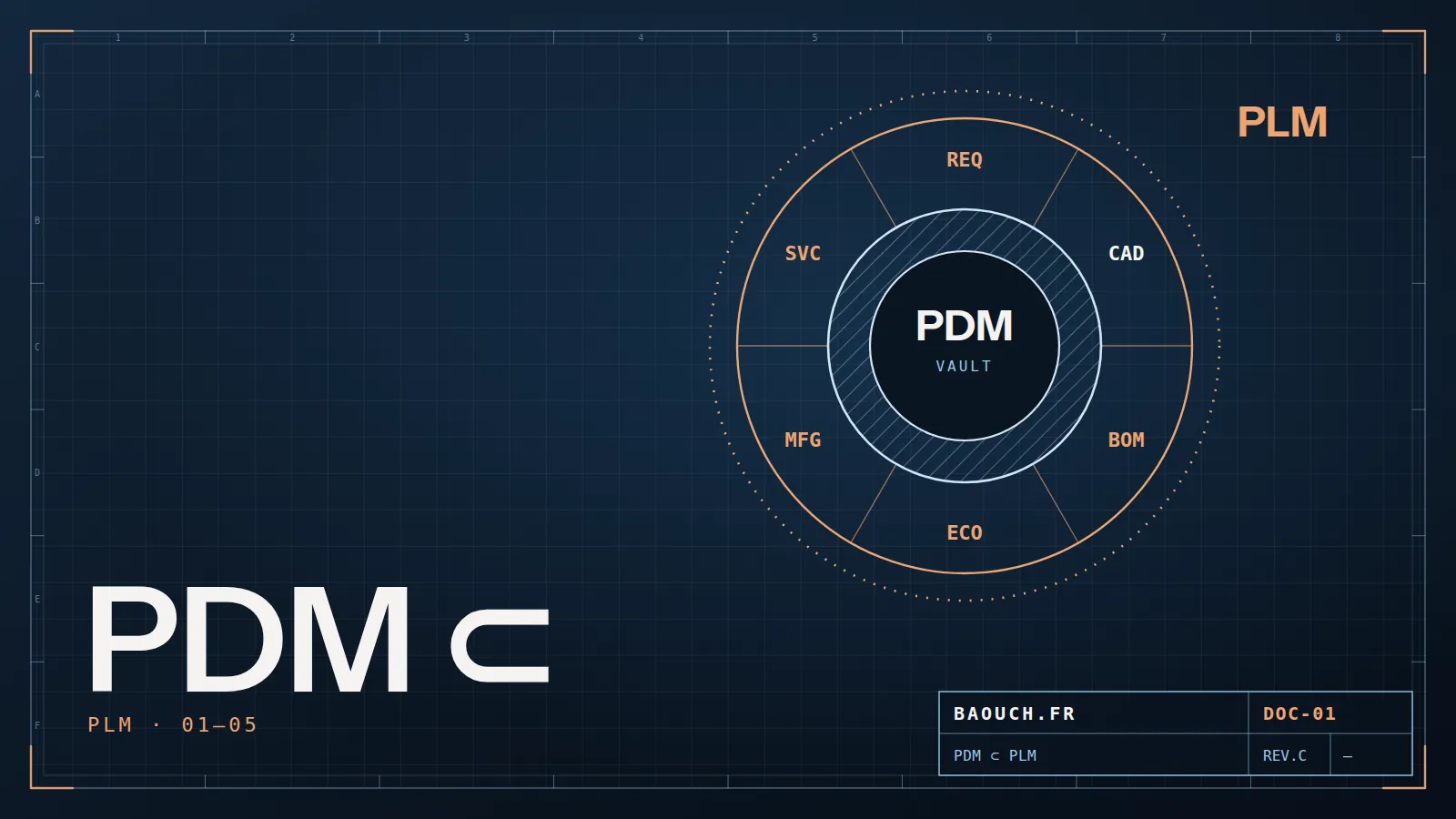
Ask "do you have a PLM?" to ten industrial SME leaders, and eight will say yes. Look under the hood, and seven times out of ten you'll find a PDM — an excellent CAD vault, versioned and secure — that everyone calls "the PLM" out of habit. And you know what? That's not a problem.
The problem appears the day the company has outgrown its PDM without realizing it. The symptoms are there — proliferating spreadsheets, meetings to figure out "which version is at which customer," changes getting lost — but nobody links them to the right cause. People blame the staff, the tool, the lack of rigor. When in fact they've simply crossed a line.
This article gives you the 5 concrete signals of that crossing. Read them as a checklist: zero ticked, your PDM is perfect, keep your money. Three or more, we need to talk. The 4th signal triggers the most panicked calls.
Quick recap: a PDM manages data (CAD files, eBOM, revisions). A PLM manages the processes that make that data evolve. The PDM answers "what did we design?". The PLM answers "why, for whom, and what downstream?".
Signal 1 — Parallel spreadsheets multiply
An ECO log in Excel. A "compatibility matrix" file on the network. Another for the list of customer requirements. A third to know which projects use which part. Each spreadsheet was born from a real need — one the PDM couldn't cover.
These spreadsheets are the symptom, not the disease. They prove your processes have grown faster than your tool. Each new spreadsheet is a small piece of PLM you've rebuilt by hand, without knowing it.
Signal 2 — Which version is at which client?
This is the PDM's black hole. Your vault knows perfectly which is the latest revision of a part. But if a customer calls about machine #247 delivered two years ago, do you know exactly which configuration it carried? Which revisions, which options, which compatible spare parts?
A packaging-line builder spent half-days, on every service call, reconstructing the delivered configuration from old emails and paper drawings. The PDM only traces "the product." The PLM traces "that product, as it shipped, to that customer."Mohamed Omar Baouch
This need — configuration management — is the first one a PDM structurally cannot cover. If your service team is struggling, this signal is already lit.
Signal 3 — Changes are managed by email
"Can you tweak part 1245, we've got an assembly issue?" — sent, received, applied. No record of the decision, no impact analysis, no effective date. It's fast, it's human, and it's exactly how a phantom revision reaches production.
A PDM can version a part. It can't orchestrate a change: request, cross-functional impact analysis, approval, propagation to the ERP, closure. That process (ECR/ECO) is the heart of a PLM.
Signal 4 — Your disciplines don't talk (the one that hurts most)
Here's the one that triggers the most calls. Your products are no longer purely mechanical: there's electronics, wiring, embedded software, regulatory requirements. Mechanical engineering is in the SOLIDWORKS PDM. Electronics is in another tool. Software is on a Git server. Requirements are in a spreadsheet. Nobody has the full picture of the product.
That blue/purple gap is your PLM need made visible. As long as the blue zone is enough, stay on PDM. The moment your product demands the purple zone, no spreadsheet will fill the void for long.

Signal 5 — Traceability you can't provide
A quality audit, a standard (ISO, IATF, aerospace EN 9100, medical ISO 13485), a major client demanding proof of "who approved what, when, based on which requirement." If answering that today means three days digging through emails, this signal is glowing red.
End-to-end traceability — from requirement to delivered part — is structurally beyond a PDM. It's often this signal, imposed from outside, that turns a "someday interesting" PLM project into a "mandatory this quarter" one.
How to read your score:
- 0–1 signal: your PDM is the right tool. Optimize it rather than buying bigger.
- 2–3 signals: you're at the border. First formalize the processes on your current tools.
- 4–5 signals: you've outgrown the PDM. The question is no longer "if" but "which PLM, at what pace."
The real trap: over-buying out of anxiety
One last word, because it's worth gold. The danger isn't only staying on PDM too long. It's also switching too early to a heavy PLM, driven by the fear of "falling behind." I've seen SMEs buy six-figure platforms to use only the file vault — a PDM, paid ten times over, and rejected by the teams. The same reflex applies to moving to the cloud: before signing, ask the 7 questions on reversibility, 5-year cost and degraded mode.
The right PLM is the one that answers real signals, rolled out at the pace your teams can absorb. An imposed PLM is more dangerous than a PDM you own. Maturity isn't having the biggest tool — it's having the right one, and knowing why.Mohamed Omar Baouch
So count your signals. That number — between 0 and 5 — is worth all the sales demos you'll sit through this year. It tells you, in one minute, whether to optimize what you have or prepare the next step.
Frequently asked questions
When should you move from PDM to PLM?
When the subject spills beyond the design office: methods, purchasing and quality need the same truth, changes must be assessed and traced, and variants multiply. As long as the need is "find the right file", PDM is enough.
Can a PDM be enough for an SME?
Very often, yes — and that's good news, because it's the cheapest and fastest option to put in place. Many companies buy a PLM where a well-configured PDM, with a real change process, would have solved the problem.
Do you have to change tools to move to PLM?
Not always: several solutions let you extend the scope without starting over. The real switch is organisational — deciding that the product definition no longer belongs to engineering alone.
What does moving to PLM cost?
Less in licenses than in configuration, data migration and change management. The decisive item remains the state of your existing data: it's what makes the bill vary threefold.